|
Who
are the Adivasi?
In India the members of
the tribal communities are usually called “tribals” in English
language and “girijan” (hill people) or “banvasi” (foresters) in
Hindi language. The Constitution of the Republic of India
applies in its English version the term “scheduled tribes” and
in the Hindi version “anusuchit janjati”. All these expressions
contain clearly paternalistic and partly even discriminatory
connotations.
During the first decades
of the 20th century educated and politically active
tribals from eastern central India started to use the
Hindi/Sanskrit term “Adivasi”. This word consists of “adi”
(original) and “vasi” (inhabitant). Irrespective of the various
names for individual tribes the self-designated term “Adivasi”
has since become widely accepted. “Adivasi” signals awareness of
a distinct identity, of a history and culture of one’s own.
Moreover it points to a political programme to conserve and
promote these cultures and to attain self-determination in a
wider political context.
The self-designated name
“Adivasi” corresponds with the modern concept of “indigenous
peoples”. Since the 1950s representatives of indigenous peoples
have been networking on a global level under the auspices of the
United Nations. They contributed towards elaborating
international legal standards in order to preserve their diverse
traditional cultures and in order to work towards an overall
self-determined future. Against this backdrop one may refer to
the Adivasi movement as a movement for empowerment and assertion
of Adivasi identity.
Adivasi – Past and
Presence
The Adivasi
are the descendants of those first inhabitants of India, who
resisted the law and order system installed by the respective
conquerors. Over quite a long period in history the Adivasi have
been left untouched on principal. In many regions of the Indian
subcontinent the Adivasi used to live as fishermen, as nomadic
shepherds, as shifting agriculturalists and as hunters and
gatherers. Between 2500 and 1500 BC cattle-breeding pastoralists
from Western Central Asia – they called themselves “arya” i.e.
the noble ones – conquered the then densely forested land. In
order to confirm their dominance this “elite” created the caste
system, which brandmarked the orginal population as “wild” and
“uncivilized”. A certain part of the aboriginal people was
subjugated and subsequently integrated into the system of
dominance at the lowest rung as “outcastes” or “untouchables”
(today they are known as “harijans”, “scheduled castes” or “dalits”).
Thus racist discrimination started more than three thousand
years ago. This was also the beginning of continuous eviction
and withdrawal of the Adivasi.
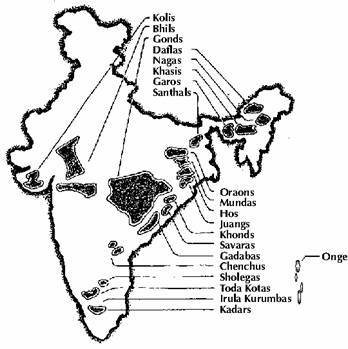
Many communities fled in
inaccessible hill areas, where they could preserve their
traditional way of life partly to this day. The Adivasi have
never been part of the economic system – except that they were
exploited as cheap labour. Their economic activities in
agriculture, animal husbandry and craft have always been
exclusively for their subsistence – not for making profit. The
Constitution of India provides quota for the scheduled tribes in
education, public service and also in the parliaments. Moreover
there are quite a few tribal development programmes. These
promotion activities do not address the specific needs of the
Adivasi. In addition they aid and abet the formation of an
Adivasi elite, which is aloof from the situation of the
majority. The government-sponsored industrialization
increasingly destroys the last withdrawal areas of the
aboriginal inhabitants. The delogging of vast forests, the
construction of huge embankment dams, mining projects and test
ranges for the army have already devastated large parts of
Adivasi areas. They have uprooted millions of them and made them
beggars in their own land.
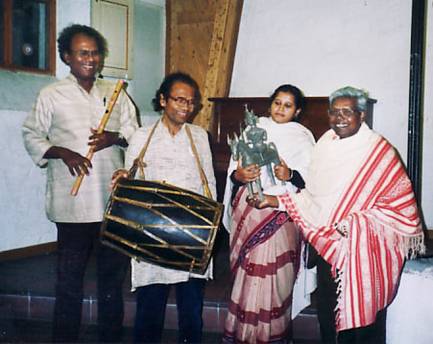
Members of
the Adivasi delegation who visited
several European countries in 1993 (Year of the Indigenous
Peoples), from left: Dr. Ram Dayal Munda, Jharkhand; Dr. Siddharaj Solanki, Gujarat; Sandhya Naik, Orissa;
Bishop Dr. Nirmal Minz, Jharkhand
|